Muscles are tissues made of fibres. They contract and relax to move. They are living engines of movement, metabolism, and resilience. They power the body and protect health. They prevent injuries and diseases. They slow ageing and even act like biochemical “brains.” These “brains” communicate with the rest of our systems.
If you are not training your body, you are missing out on all the good functions of muscles. How do you develop muscles? It is simple but hard. Start strength training with lifting weights, resistance bands, or body weight exercises. This will stimulate muscle growth. Once comfortable, start progressively overloading to gradually increase resistance. This ensures continuous development. Follow a nutrition plan. Recover through rest and sleep to rebuild stronger muscles.
Muscle mass starts declining from around age 30, which accelerates with age, leading to weakness, falls and reduced independence. Your exercise regime is a fighting mechanism activating longevity genes, improving balance and preserving mobility. A healthy muscle mass increases life expectancy and better the quality of life.
Muscles act as a reservoir of vitality, restoring glucose, growth hormones and maintaining bone density. Muscles even enhance cognition and mental health.
“It is said muscles are the new brain”, – and communicate with the rest of the body. During exercise, muscles release myokines – chemical messengers that influence the brain, immune system, and metabolism. Cognitive function reduces inflammation and protect against neurodegenerative diseases. Muscles don’t just move us—they think biochemically, guiding longevity and mental sharpness.
Building and maintaining muscle through progressive resistance training, aerobic exercise, and protein-rich nutrition involves several steps. This is one of the most evidence-based strategies to slow ageing. It helps preserve cognition and extend health span.
Some of the easily measurable muscle metrics include:
Lean Body Mass (LBM): total weight minus fat
Skeletal Muscle Index: muscle mass relative to height
Grip Strength: a strong indicator of muscle strength and longevity
VO2 max contributions: muscles’ ability to sustain aerobic work.
After only aerobic activities like running, cycling, swimming, and walking, these exercises will strengthen endurance and metabolic efficiency. Nonetheless, they do not maximize the size or raw strength of muscles.
It is always better to have an exercise plan that includes both resistance training and aerobic activities.
There is hope for everyone. Muscle growth is possible at any age. Studies show that men in their 60s, 70s, and even 80s can gain muscle with proper resistance training.
Muscle growth potential is partly genetic, but most men never reach their full capacity.
Most men can gain ~40–50 pounds of lean muscle over a lifetime.
Those who start young and train consistently can maintain high levels of muscle mass into older age.
Some fun facts about Muscles!!
There are 600 muscles in the body, making up 30 to 40 % of total body weight.
The strongest muscle is the jaw muscle. Eye muscles are the busiest muscles; they move more than one lakh times a day as they adjust to focus. The largest muscle is the gluteus maximus (buttocks). The smallest is the stapedius in the ear. It is just 1 mm long and helps control sound vibrations. The longest muscle is the sartorius, running from hip to knee, helping us to cross our legs.
Muscles do not just move; they generate heat, too.
Muscles can only pull, not push.
The tongue is not just a single muscle – it’s a complex group of muscles working together.
Without exercise, people can lose up to 80% of their muscle strength by age 65.
Muscles need water to stay lubricated and energized. Dehydration makes them stiff and prone to cramps.
Muscles never sleep; even when we are resting, muscles like the diaphragm and heart keep working nonstop
Muscle memory is real! Once a muscle is trained, it remembers, making it easier to regain strength after a break.
Muscles are water-rich- about 75% of muscle mass is water.
Muscles generate electricity.
Muscles talk to fat – signaling fat tissue to burn more energy.
Muscles adapt to stress.
Muscles can twitch after death – electrical activity can cause small contractions for hours post-death.
Happiness—so simple in word, yet so complex in experience—is a topic that transcends boundaries. Whether you are a scientist probing the mysteries of the mind, a farmer tending to the soil, a billionaire navigating boardrooms, or a homemaker nurturing a family, the pursuit of happiness touches us all.
For many, happiness feels like a mirage—visible but unreachable. We chase it through achievements, possessions, and milestones, only to find it slipping through our fingers. Why is it so elusive?
Happiness is not a product of status, wealth, or external validation. It is a state of being—rooted in awareness, connection, and meaning.
A person surrounded by luxury still feels empty. In contrast, someone living modestly—like a farmer in the fields—radiates joy and contentment.
The Dalai Lama has said, “Happiness is not something readymade. It comes from your own actions.”
What Is Happiness?
Happiness is not a destination—it is an inner state of being. It is the quiet harmony of contentment, joy, tranquility, and peace. When the body and mind are at ease, and a persistent feel-good factor flows through us, we touch the essence of happiness.
Happiness is a multidimensional phenomenon:
Physiological: Neurotransmitters like serotonin, dopamine, and oxytocin create emotional sensations.
Psychological: It involves emotional regulation, self-awareness, and cognitive alignment.
Spiritual: It’s a sense of connection to something greater—purpose, meaning, or transcendence.
True happiness arises when we live in our authentic persona, uphold our true personalized values, pursue personal growth and meaningful engagement that align with our life purpose or discover our ikigai.
Real, caring, and loving friendships are a profound source of happiness. These are the people whom you trust deeply, whom you can call at any time, for any reason and those who offer emotional safety and shared joy.
Happiness does not come from the relentless pursuit of success. Happiness does not live in wealth or material possessions, and it is not found in external validation.
Paradoxically, though happiness is an internal mechanism, many seek it in the external world—through achievements, acquisitions, or approval. But the truth remains: happiness begins within.
Happiness and Pleasure
Are they the same? Not necessarily. Pleasure is externally induced. It is a momentary feeling. Examples include having a sumptuous meal, alcohol, a hug, making love, or a massage. No doubt, one is happy for a short while. Still, it is not long-lasting because it is stimulated by external factors. No doubt, one will have to keep experiencing such situations. This comes at the cost of becoming addicted to such experiences. It results in a short-lived feeling of happiness. Pleasure is part of happiness, no doubt, but not its whole part.
Pleasure from external factors is also unsustainable and requires chasing, and is hard to support. To be lastingly and sustainably happy, one needs to do something more. This includes developing strong bonds and relationships. It also involves being kind and of service to others, and searching for something of a higher purpose.
What are the three most important causes that lead to happiness? They include a sense of resilience, which involves self-awareness, mastery, shifting mindsets, and self-regulation. Another cause is lasting optimism, which means being aware, open, and clear. Lastly, the feeling of compassion encompasses feeling, caring, understanding, and helping others.
A simple prescription for happiness? Read on:
Be Aware of Emotions — The Power of Self-Awareness
Emotions are the undercurrent of our daily lives. Emotions make humans! We experience fleeting joy and lingering sadness. We feel quiet jealousy and explosive anger. Each feeling is part of the richness of being human.
On average, we experience around 400 emotional states every day. That is not a flaw—it’s a feature of our emotional complexity. And the key to navigating this inner world is simple yet profound: be aware of the emotions you experience.
Recognition is the first step to transformation. Accept your emotions as they are. Let emotions move through you. Once you are aware, it is no longer that emotion and the adverse effects of those emotions keep receding. Self-awareness is golden!
Emotions are messengers—not enemies. When we listen to them with compassion and clarity, they guide us toward deeper understanding and growth.
There is nothing called perfection
Perfection is only a myth. Let us settle it once and for all – perfection does not exist.
Yet, many of us chase it relentlessly. We polish, tweak, overthink, and over analyze. This continues until we are drained of energy, stressed, fatigued, and emotionally spent. The pursuit of perfection is a trap that leads to exertion without fulfillment.
Shift the Focus: Progress, Not Perfection
Small, perceptible improvements are meaningful.
Focus on actions that influence outcomes.
Develop bias for action — a mindset and skill that values doing over dithering.
Why Action Beats Perfection
Action creates momentum. Perfection stalls it.
Learning comes from doing, not from waiting for the “perfect” moment.
Growth is iterative. Each step ahead refines your path.
Perfection is a mirage. Progress is real. Choose movement over mastery, and you’ll find clarity, confidence, and results.
Achieve Smaller Milestone Goals — The Power of Micro-Wins
Big goals can feel overwhelming. But when you break them down into smaller, manageable milestones, they become achievable, motivating, and even enjoyable.
Why Micro-Milestones Matter
They make complex goals less intimidating.
They give clear direction and measurable progress.
They build momentum through consistent achievement.
Celebrate Small Wins
Every micro-win is proof of progress.
Celebrating small victories boosts dopamine, reinforcing motivation.
It creates a positive feedback loop that fuels long-term success.
Success in not a single leap—it is a series of steps. Honor each one, and the end goal will be that much more achievable.
Stress? Shed It — Reclaim Your Peace of Mind
Stress is not a badge of honor. It is a burden—one that weighs heavily on both body and mind. Stress is widespread and has become a societal phenomenon. Look at the statistics below:
80 % of people experience stress daily to varying degrees.
Only 6% report never feeling stressed at all.
1 in 2 urban Indians (55 %) say stress affects their daily lives.
A stressed mind becomes a storehouse of negativity, clouding judgment, draining energy, and eroding well-being.
Emotional toll: strained relationships, loss of joy.
How to Handle and Avoid Stress
Focus on doing your best, not being perfect.
Practice mindfulness, deep breathing, or short meditative breaks.
Rank tasks and break them into manageable steps.
Talk it out—do not bottle it in.
Stress thrives in pressure. When you shift your focus from control to clarity, from perfection to progress, stress begins to lose its grip.
Do your best—without being burdened. That is not just wise—it is liberating. Do not be burdened by stress. And don’t be a source of stress!
Enjoy the Simple Moments — Embrace the Glimmers of Joy
Happiness is not always found in grand achievements or life-altering events. More often, it lives quietly in the smallest of moments—what psychologists now call glimmers.
What Are Glimmers?
Glimmers are micro-moments of joy, calm, and safety. They are fleeting, subtle, and often overlooked—but they carry immense emotional power.
Spotting a rainbow after the rain
Hearing your favorite song unexpectedly
Feeling the warmth of morning sunlight on your skin
Watching a bird flutter by or a leaf dance in the wind
Sitting quietly, feeling at peace with yourself
These moments do not shout—they whisper. And when we learn to notice them, they become anchors of happiness in our everyday lives.
Why Glimmers Matter
Trigger the parasympathetic nervous system, calming the body
Build emotional resilience through positive reinforcement
Foster gratitude, presence, and a sense of connection
Help rewire the brain toward joy and safety, especially in times of stress
How to Cultivate Glimmers
Practice mindful awareness—slow down and notice the beauty around you
Create space for quiet reflection, nature, and sensory delight
Share glimmers with others—it multiplies the joy
Be Here, Now — The Art of Living in the Present
Consciously or unconsciously, our minds wander. They drift into the past, replaying memories, regrets or fantasies. They leap into the future, laying stories of what will be. And in doing so, we lose touch with the only moment that truly matters: the present.
The Illusion of Time
The past is done once and for all, never to return or reappear. It has gone into an abyss of no return. No amount of thinking can rewrite it.
The future is a mirage—unformed, uncertain, and often exaggerated.
We spend our most productive energy dwelling on what was. We also dwell on what be. Instead, we should engage with what is.
Why the Present Is Powerful
The present is where life happens or unfolds.
It is the only place where action is possible.
It’s where we can shape the future, not fantasize about it.
The past takes us nowhere. The future drains us in daydreams. But the present—this moment—is where happiness begins.
How to Practice Presence
Breathe deeply. Consciously noticing your breath will bring you to the present time.
Notice your surroundings—the colors, sounds, textures.
Sit quietly. Let thoughts pass like clouds, without chasing them.
Reflect: What am I experiencing right now?
Do Not Worry, Be Happy — Let Go of What You Can’t Control
Worry is a silent thief—it steals peace, joy, and clarity. And yet, it is incredibly common:
4.4% of the global population suffers from anxiety disorders.
42% of people report experiencing frequent worry.
But here is the truth: most worry is wasted energy, especially when it is about things beyond our control.
Why Worry Doesn’t Help
It creates mental loops with no resolution.
It blocks creativity and problem-solving.
It drains emotional resilience.
What to Do Instead
Focus on what you can control—your actions, mindset, and choices.
If there is no solution, pivot or let go.
Practice acceptance: not everything needs fixing.
Cultivate joy through gratitude, movement, and connection.
Worry is a habit. Happiness is a choice. When you stop feeding fear and start nurturing hope, you reclaim your power.
Find Your Purpose — The Journey Toward Meaningful Living
Viktor Frankl, a renowned psychiatrist and Holocaust survivor, believed that finding meaning is the cornerstone of human resilience and fulfillment. He wrote, “Those who have a ‘why’ to live can bear almost any ‘how’.”
Yet, the search for purpose is not always straightforward
95% of people struggle to clearly define their life’s purpose.
This reflects the diverse ways we perceive meaning and the challenges in discovering it.
Why Purpose Matters
It gives direction to our choices.
It fuels motivation and perseverance.
It fosters authenticity and inner peace.
How to Move Toward Purpose
This is easier said than done. It requires effort to articulate the true purpose of your living. But a beginning is half done.
Self-reflection: What truly matters to me? Why do I want to lead the life I envision? Do I want to let life pass by while I stay in a fog of confusion? Deep reflection clears the mental clutter and opens up the path towards clarity. Cloud of confusion and take a step towards your life purpose.
Explore Your Inner Landscape: and think upon your core values, passions, and impact you wish to make. What contributions feel meaningful?
Articulate Your Purpose: Write it down, even if it feels incomplete or fluid.
Put Timeframes: Short-term (what energizes you now?), Medium-term (what are you building towards?), long-term (what legacy you wish to leave?)
Embrace evolution: As you evolve as a person, so will your purpose. Allow space for change, refinement, and rediscovery.
Be Guided by Values — The Compass for a Meaningful Life
A meaningful life is not built on achievements alone—it is shaped by the values we choose to live by. These values act as our internal compass, guiding our choices, actions, relationships, and decisions. A happier life is built on a solid foundation of a core set of values.
Why Values Matter
They shape our character and define our authenticity.
They offer clarity in moments of uncertainty.
They influence how we connect, lead, and respond to the world.
Are you confused about how to continue with setting values for yourself? To start with, consider the next values to start with. Do they resonate with you?
Common Core Values for Fulfillment
Integrity — doing what’s right, even when no one’s watching.
Kindness — treating others with warmth and respect.
Compassion — understanding and supporting others in their struggles.
Honesty — being truthful and transparent in thought and action.
Passionate pursuit and pursuing these values is crucial in all life situations. Let your choices show your principles, even when it is hard. Build and add on to them as you consider fit.
Recognize and move onward with your guiding principles. Practice them in your life. When you align your life with your values, you do not just exist—you lead with purpose, authenticity, and grace.
Pursue What Is Close to Your Heart — The Path to Fulfillment
Steve Jobs once said:
“Have the courage to follow your heart and intuition. They somehow already know what you truly want to become. Everything else is secondary.”
These words echo a timeless truth: your heart knows your path. But life often complicates that journey.
The Reality Check
Economic pressures, responsibilities, and societal expectations can pull us away from what we truly love.
Many people suppress their passions for practicality.
This disconnect can lead to dissatisfaction, burnout, or a sense of being lost.
Why Pursuing Your Heart Matters
It leads to greater happiness and fulfillment.
It fuels intrinsic motivation—you do it because you love it.
It nurtures authentic growth and self-expression.
Listen to your heart. Honor its whispers. Eventually, they’ll lead you home.
Think Positively — Rewire Your Mind for Resilience
Positive thinking is not just feel-good fluff—it is a mental discipline that shapes how we experience life, build resilience, and navigate challenges.
It is estimated that:
The brain generates up to 60,000 thoughts per day.
About 90% are repetitive, looping through familiar patterns.
A staggering 80% of these thoughts are negative, reflecting our brain’s bias toward threat detection and survival.
This negativity bias often leads to stress, anxiety, and emotional fatigue.
How to Train Your Mind for Positivity
Gratitude journaling: Write down 3 things you are thankful for daily.
Positive affirmations: Speak kind truths to yourself.
Mindful awareness: Notice negative thoughts without judgment, and gently redirect.
Surround yourself with uplifting people and environments.
Train your mind. Choose your thoughts. Cultivate joy and happiness.
Have Fun — The Secret Ingredient to a Fulfilling Life
In the pursuit of goals, growth, and greatness, we often forget a simple truth: fun fuels fulfillment. When we embrace joy and non-serious playfulness, the journey becomes not just bearable but beautiful.
Why Fun Matters
Boosts positivity and emotional well-being
Reduces stress and promotes relaxation
Encourages humility and gratitude
Enhances creativity, motivation, and mental clarity
How to Prioritize Fun
Engage in hobbies that spark joy—art, music, games, writing, movement, exercise. Etc.,
Spend time with people who make you laugh and feel alive.
Explore nature, travel, or new experiences with a sense of wonder.
Turn everyday tasks into playful challenges or creative rituals
Seek Feedback — The Mirror That Reveals Growth
We are all works in progress—learning, evolving, and sometimes stumbling. It is very important to seek feedback on how we are doing. Others can see our blind spots, which we don’t. So, for a happy living, seek feedback from others and take actions to bridge the gaps.
Why Feedback Matters
Reveals blind spots we can not see on our own.
Enables course correction and continuous improvement.
Encourages open communication and deeper relationships.
Consider genuine feedback as a gift, not a judgment.
Feedback is not criticism. It is clarity. It is someone saying, “I care enough to help you grow.”
How to Embrace Feedback
Ask openly: Invite feedback from trusted peers, mentors, friends or loved ones.
Be open-minded: You may get inputs which may be surprising, but be open-minded.
Listen without defensiveness: Receive it with grace, not resistance.
Reflect and act: Use it to make meaningful changes.
Express gratitude: Thank those who offer honest insights.
“Feedback is the breakfast of champions.” — Ken Blanchard
Treat feedback as fuel. It may not always taste sweet, but it nourishes your growth, happiness, and self-awareness.
Self-Evaluate — The Habit That Shapes Excellence
To be happy, self-evaluation is a key factor. True growth begins within. While feedback from others is invaluable, self-evaluation is the compass that keeps us aligned with our values, goals, and potential.
Why Self-Evaluation Matters
Encourages self-awareness and emotional intelligence
Helps find patterns in behavior, choices, and outcomes
Guides intentional improvement and goal alignment
Prevents repetition of mistakes, saving time and energy
How to Practice Self-Evaluation
Daily check-ins: Before calling it a day, ask yourself—What went well today? What could I have done better? Was it right for me to do it this way? Why did I say those words which could have hurt? Spend only a few minutes on these questions, based on your own evaluation. If you have made a mistake, take action to correct it. And do not repeat those mistakes!
Journaling: Write down key actions, reactions, and lessons learned.
Increase Generosity — The Ripple Effect of Kindness
Generosity is not just about giving—it is about connecting, uplifting, and transforming. A single act of kindness can echo far beyond the moment, creating waves of joy and healing.
Why Generosity Matters
Strengthens relationships through trust and empathy
Reduces stress and fosters emotional well-being
Boosts self-esteem and a sense of purpose
Sparks a chain reaction of positivity and goodwill
Offers a chance to give back and contribute meaningfully to society
Generosity is a quiet superpower—it elevates both the giver and the receiver.
How to Cultivate Generosity
Offer a kind word, a listening ear, or a helping hand
Share time, resources, or opportunities with those in need
Practice random acts of kindness—no gesture is too small. A simple act of kindness is a matter of immense joy.
Reflect on how giving makes you feel—and let that joy guide you
Have More Friends — The Heartbeat of Happiness
Friendship is one of life’s greatest treasures. It’s not just about companionship—it is about belonging, support, and shared joy. In moments of celebration or struggle, friends are the ones who make life feel truly lived.
Why Friendship Matters
Boosts happiness and emotional well-being
Reduces feelings of loneliness and isolation
Provides support and resilience during tough times
Builds a sense of belonging and purpose
Being alone may offer peace, but being with friends offers connection. Social connections offer happiness and are known to enhance longevity.
Quality Over Quantity
You do not need hundreds of friends—just a few genuine ones who truly care.
True friends show up when it matters most, not just when it is convenient.
Be the kind of friend you wish to have—loyal, kind, and present.
How to Cultivate Meaningful Friendships
Invest time in real conversations, not just surface-level exchanges.
Share experiences—joys, struggles, and everyday moments.
Be there for others, especially when they need you most. Be the first to reach out when someone is in need.
Manage Work-Life Balance and Workload — Protect Your Energy, Preserve Your Joy
In today’s fast-paced world, the lines between work and life often blur. But balance is not a luxury—it is a necessity. Your work may be meaningful, but your life is irreplaceable.
Why Work-Life Balance Matters
Reduces stress, anxiety, and emotional fatigue
Strengthens relationships and personal fulfillment
Enhances focus, creativity, and productivity
Prevents burnout and long-term health issues
Reminds you that you are more than your job
How to Create Balance
Set boundaries: Protect weekends, holidays, and personal time
Prioritize rest and recovery as much as performance
Learn to say no to excessive responsibilities
Delegate, simplify and focus on what truly matters
Invest time in relationships, hobbies, and self-care
Managing Workload Wisely
Avoid multitasking—focus brings efficiency
Regularly assess your commitments and adjust
Recognize when “too much” is too much—and act before it overwhelms
The Art of Saying “No”
Saying “no” is not selfish—it is self-respect. Yet many struggle with it, fearing rejection, guilt, or the loss of approval. As a result, they take on more than they can handle, sacrificing their peace, time, and well-being.
But here’s the truth: you don’t earn respect by always saying yes—you earn it by knowing your boundaries.
Why Saying No Is Powerful
Protects your mental and emotional health
Preserves time for what truly matters
Builds self-confidence and clarity
Before committing, ask:
Is this aligned with my goals or values?
Do I have the time and energy for this?
Will this bring me joy or drain me?
If the answer is no, say it clearly and kindly. You don’t owe anyone an elaborate excuse. A simple, respectful “I can’t take this on right now” is enough.
Saying no is not rejection—it’s redirection toward what serves you best.
Pause. Think. Proceed.
Life throws countless situations at us—some expected, many not. In the rush of daily living, it is easy to react impulsively, letting emotions take the wheel. But reaction without reflection often leads to misunderstanding, conflict, and regret.
Instead, choose the mindful path:
Pause: Take a breath. Step back from the heat of the moment.
Think: Reflect calmly. Consider the consequences, the context, and the people involved.
Proceed: Respond—not react—with clarity, empathy, and intention.
Why It Matters
Impulsive reactions can trigger a cascade of negativity:
Escalated tensions
Miscommunication
Damaged relationships
This simple practice—pause, think, proceed—can transform how we navigate challenges, making us more grounded, wise, and compassionate.
Be Grateful — A Gateway to Joy
Gratitude is more than a polite gesture—it’s a transformative mindset. When we embrace gratefulness for all that life offers, we unlock a deep reservoir of happiness. This includes life’s challenges.
The global “Be Grateful” movement is not just a trend—it is a powerful shift in consciousness. Those who practice gratitude regularly experience profound benefits, both emotionally and physically.
The Science Behind Gratitude
When we feel grateful:
The brain releases dopamine and serotonin, neurotransmitters linked to happiness and reward.
These chemicals trigger pathways that reduce stress, elevate mood, and improve overall well-being.
Even physical health improves, with lower blood pressure, better sleep, and stronger immunity.
The Power of “Thank You”
Each “thank you” we say is a reflection of our inner joy. It’s a small phrase with immense power—both for the speaker and the listener.
So, make gratitude a daily ritual:
Reflect on what went well today.
Keep a gratitude journal.
Say “thank you” often—and mean it.
Gratitude does not just change your day—it can change your life.
The Privilege of Being of Service
To serve others is one of the most profound privileges we can experience. True service is not about seeking recognition or reward—it is about offering help with a full heart and open hands.
Across the world, countless individuals find deep, lasting happiness simply by being of service to those in need. This is not just emotional—it is biological. Acts of kindness stimulate the release of feel-good hormones like oxytocin and endorphins, which trigger the brain’s pleasure centers. The result? A natural sense of joy, calmness, and connection.
So, make it a practice:
Seek out those who may be struggling or in need.
Reach out with empathy and generosity.
Be of service, not for praise, but for the quiet fulfillment it brings.
In serving others, we often discover the best parts of ourselves.
Self-Care — The Foundation of Inner Strength
In the rush of responsibilities and routines, we often forget the most essential relationship of all. It is the one we have with ourselves. Neglecting self-care leaves us vulnerable—physically, emotionally, and spiritually.
Self-care is not selfish—it is sacred. It’s how we replenish the energy we give to others.
How to Practice Self-Care
Go for a walk—let movement and nature soothe your mind
Engage in physical activity—release tension and boost endorphins
Pursue a hobby—immerse yourself in something that brings joy
Treat yourself to a massage or moments of stillness
Embrace hugs, connection, and quiet companionship
Happiness is not t a fixed destination—it’s a journey of episodes, moments, and mindful choices. The more you experience happiness, the more you train your mind and body to recognize, get, and recreate it.
Discover Your Code for Happiness: What lifts your spirit? What activities, people, or places make you feel alive? What values and rhythms align with your inner peace?
Your happiness code is unique to you. Find it. Honor it. Repeat it.
You can shape your happiness through Thoughts, behaviors and decisions.
Unless you are a monk in a Himalayan monastery, do not expect to live in a constant alpha state of bliss. Life is dynamic. Emotions ebb and flow.
Enjoy happiness when it visits. Invite it often. But do not chase it endlessly.
Let happiness be a companion, not a condition. Celebrate it when it comes, and trust that it will return—especially when you live in alignment with your truth.
Fun Facts about Happiness
Countries with the happiest people: Finland, Denmark, Iceland, Ireland, and Sweden have the happiest people in the world.
The Happiness Equation: 35% of happiness is decided by genes; 55% decided by life choices/activities (nurturing relationships, practicing gratitude, or seeking life fulfilling activities, life experiences, etc.), and 10% decided by life circumstances (income, health, social status, etc.).
The world’s happiest person: Matthieu Ricard is a French-born, Tibetan Buddhist monk. He lives in the Himalayan region of Nepal’s Shechen Tennyi Dargyeling Monastery. He is the happiest person in the world.
Neurotransmitters in the brain (Dopamine, Serotonin, Oxytocin, Endorphins, and Norepinephrine) produce emotions and pleasant “happiness” feelings.
The main happiness neurotransmitter, serotonin, mediates satisfaction and optimism and is released in the intestines (95%).
The brain needs regular rest (at least 15 minutes). Checking FB/Insta/Snapchat or other social media networks does not rest the brain. Our brain is not a server – it is a biological system and can not work without a break.
People who consider themselves happy are 22% less to develop cardiovascular disease.
Women are happier than men (44% and 22%)
Single and financially independent women are happier. Followed by single women vis-à-vis single men.
Married people are mostly happier than other groups (single, divorced, or widowed).
Having a child reduces happiness on average by 0.24%.
Older people are happier as they age, especially after 50 years.
White-collar job holders are happier than blue-collar job holders.
Friendship variables account for 58% of the variance in happiness.
Animal happiness: When rabbits get happy, they start to jump around. This move is called a Binky; for dogs and cats, it is called Zoomies.
Top factors that make people most happy – acts of kindness, expressing gratitude, exercise, friends, pets, sunlight, smiling, sleep, meditation, rest, and experiences…
In Conclusion: The Art of Being Happy
Happiness is not a destination—it is a dynamic, evolving experience. And the truth is, there is no one-size-fits-all answer. But there is a path, and it begins with awareness.
What We Need to Do:
Understand happiness: Learn what it truly means to you and what influences its presence in your life.
Honor your uniqueness: Your happiness is as personal as your fingerprint. What uplifts you may differ from others—and that is beautiful.
Recognize stress: Life’s pressures affect your energy, mood, decisions, and even your health span. Awareness is the first step toward healing.
Choose positivity: Negativity clouds joy. Cultivate optimism, gratitude, and hope—they are powerful antidotes.
Know your rhythms: Discover what fuels your productivity. Learn how much rest you need. Find which foods and activities nourish your body and soul.
Train your happiness: Yes, happiness is a skill. You can nurture it through habits, mindset shifts, and intentional living.
The Good News
You have the power to create the conditions for your own sustainable happiness. It is not about perfection—it is about presence, purpose, and practice.
Do not worry. Be happy. 😊 Let this be your gentle mantra, your daily reminder, your invitation to live with joy.
A fitness-related post, fitness activities, training metrics and goal and few learning:
For starters, I have several years of experience in my fitness journey. I am extremely fitness-focused. I place myself at medium to advanced levels of skill. Understand what it takes to be fit and follow a strict physical fitness regimen.
Fitness activities:
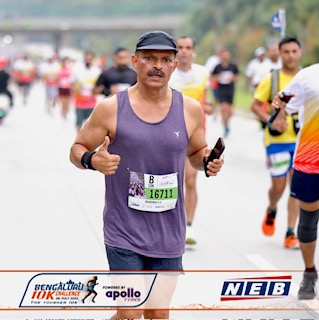
Running – Have been running for more than a decade. The longest I have run is 50 km in an ultramarathon event. Initially, I trained and ran full marathons (42.2 km). In the last 5 years, I have been training and running the half marathon (21.1 km). Now, I take part in 3 to 4 running events (half marathons/10 km) per year. I generally have one training run every week.
Bengaluru 10K Challenge Run June 2025
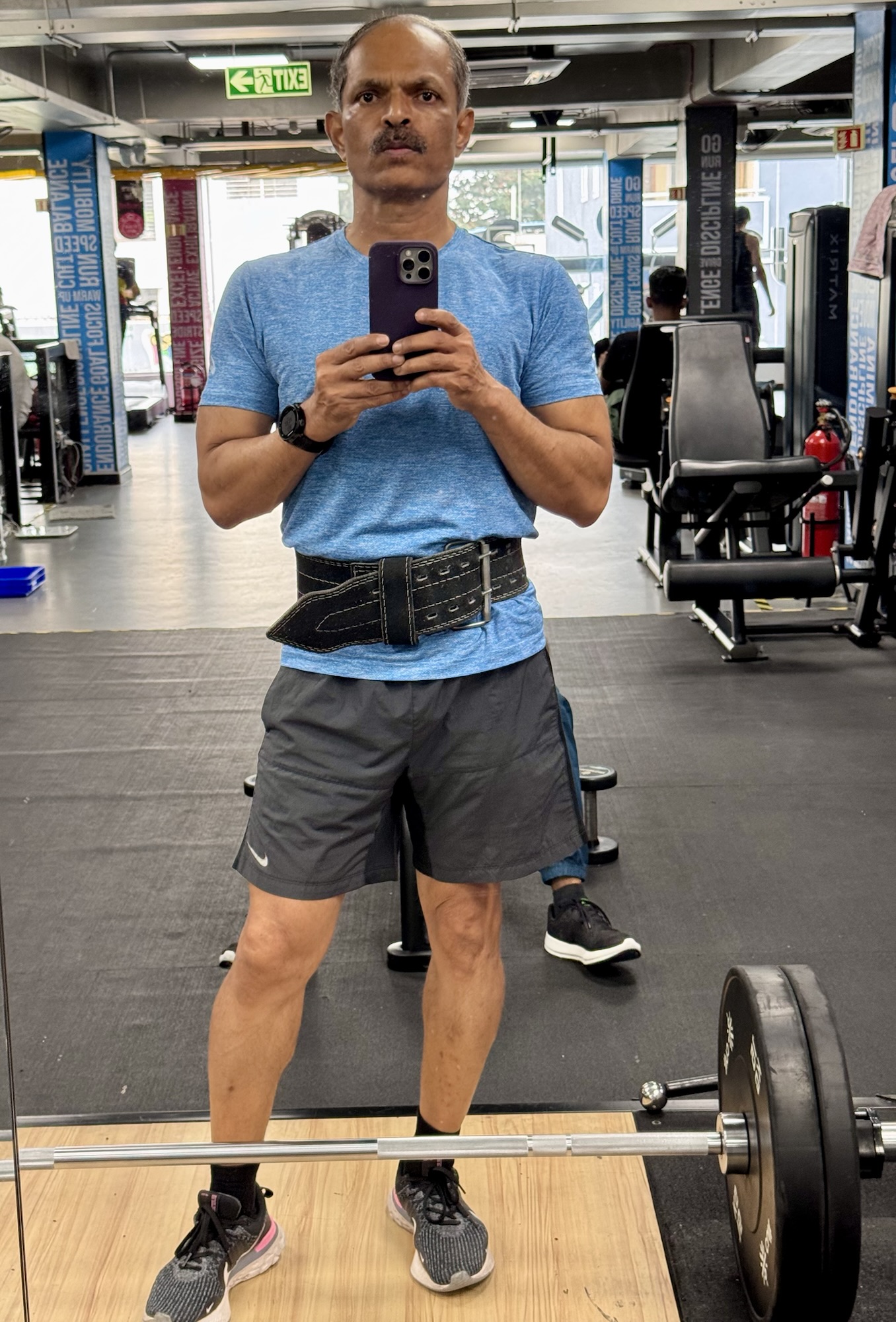
Strength Training: I love strength training and in particular, resistance training and lifting weights. I have been strength training for more than a decade and have reached decent skill and performance levels. As I age, it remains the only credit in my fitness balance. It will protect me in my fitness journey and lifespan.
The focus of my fitness regimen in the last 6 months has shifted. For several years the focus was on running with strength training supporting it. In the last six months, the whole focus has been on strength training while running supports my cardio training. The shift in focus has been fabulous and my physique is undergoing a steady transformation.
I track every exercise I do in terms of – type of exercise/sets/reps/volume of weight, etc. My progress has been very good. For several exercises, I am hitting my Personal Record (PR) consistently. Also feel physically very strong, energetic. The training metrics that I track are also undergoing change for the better.
Training Metrics
Below are the metrics that I track and the training goals I want to achieve.
Training Parameter
Training Metric
Goal
Weight
68 (hovers between 67 to 70 kg)
65 kg
Skeletal Muscle Mass
30
35
Percent Body Fat
19
15
Waist Hip Ratio
0.86
0.80
Visceral Fat Level
Level 5
Level 4
Basal Metabolic Rate
1550
1650
Resting Heart Rate
45
43/44
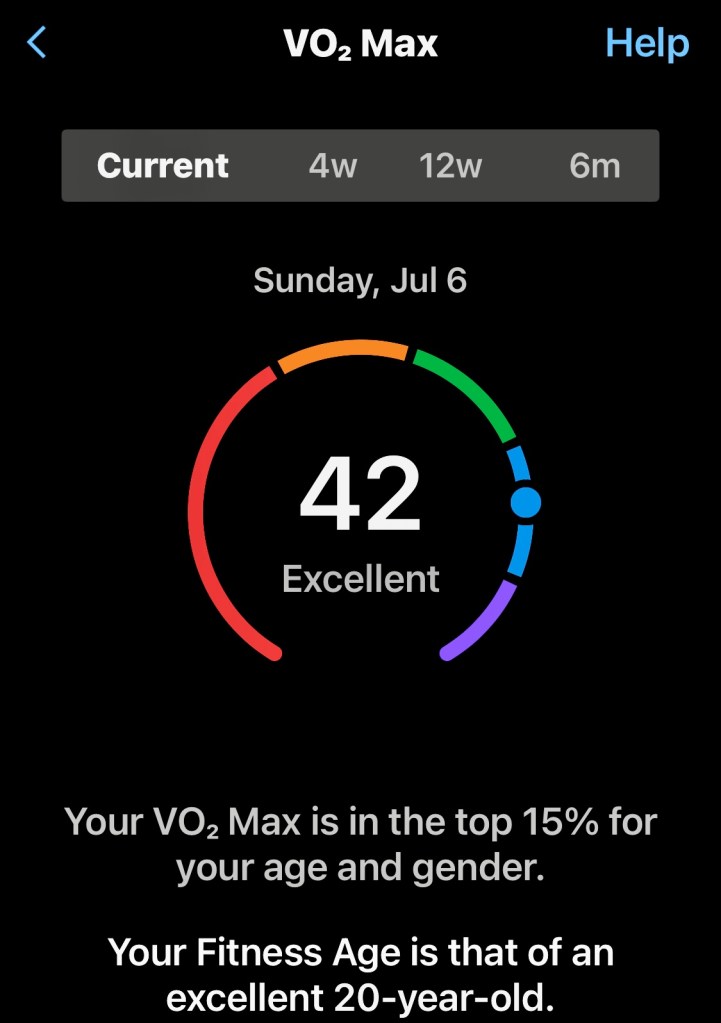
VO2 Max
42
45
The above have been achieved after sustained efforts and consistent discipline towards fitness and life style. I consider Percent Body Fat and Skeletal Muscle Mass are challenging goals. The effort required for even a small incremental improvement is hard to come by.
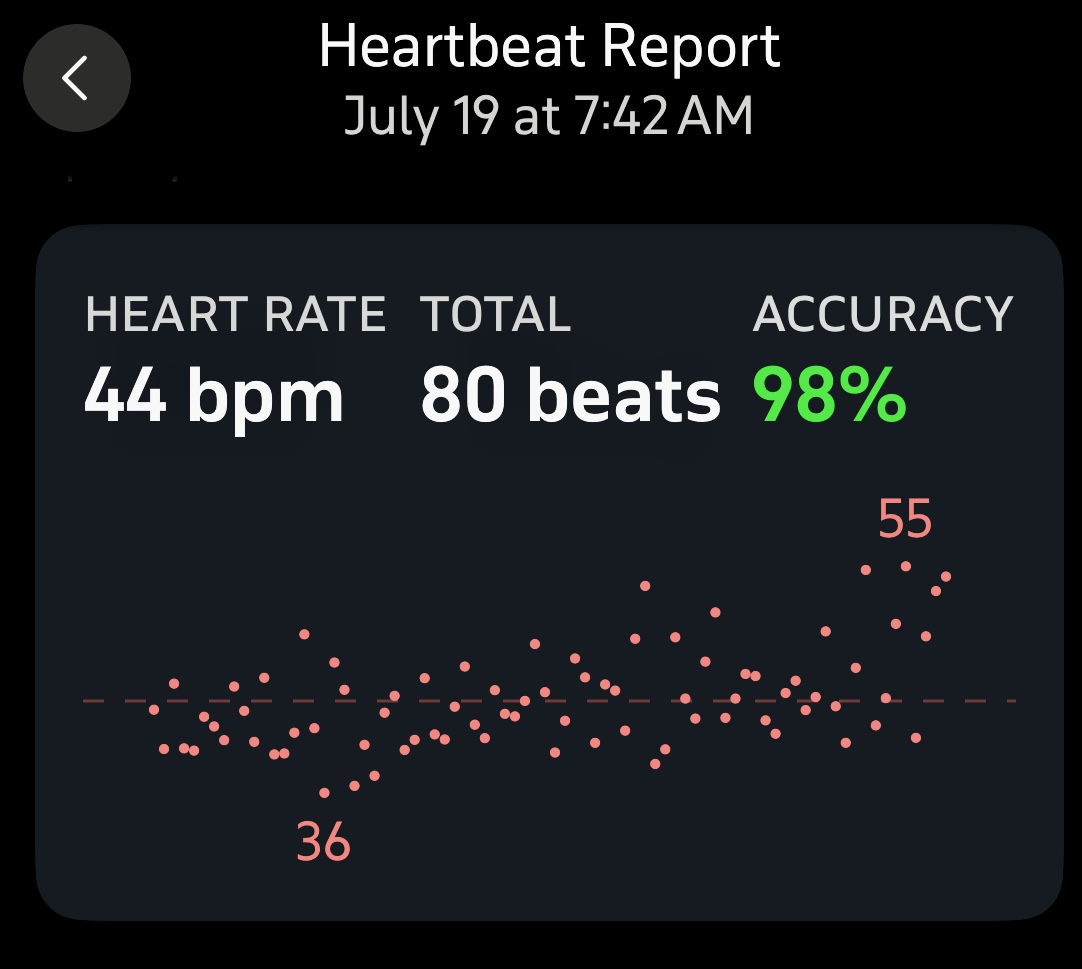
Resting Heart Rate (RHR) is the number of times your heart beats per minute when you are at rest. It is best taken within a few minutes of getting up in the morning. I am proud of the low Resting Heart Rate of 45 itself. This is an achievement and a sign of efficiency and good cardiovascular health. The lowest average I have gone a few times is in the range of 42/43. And a lowest recorded heart beat is 36!
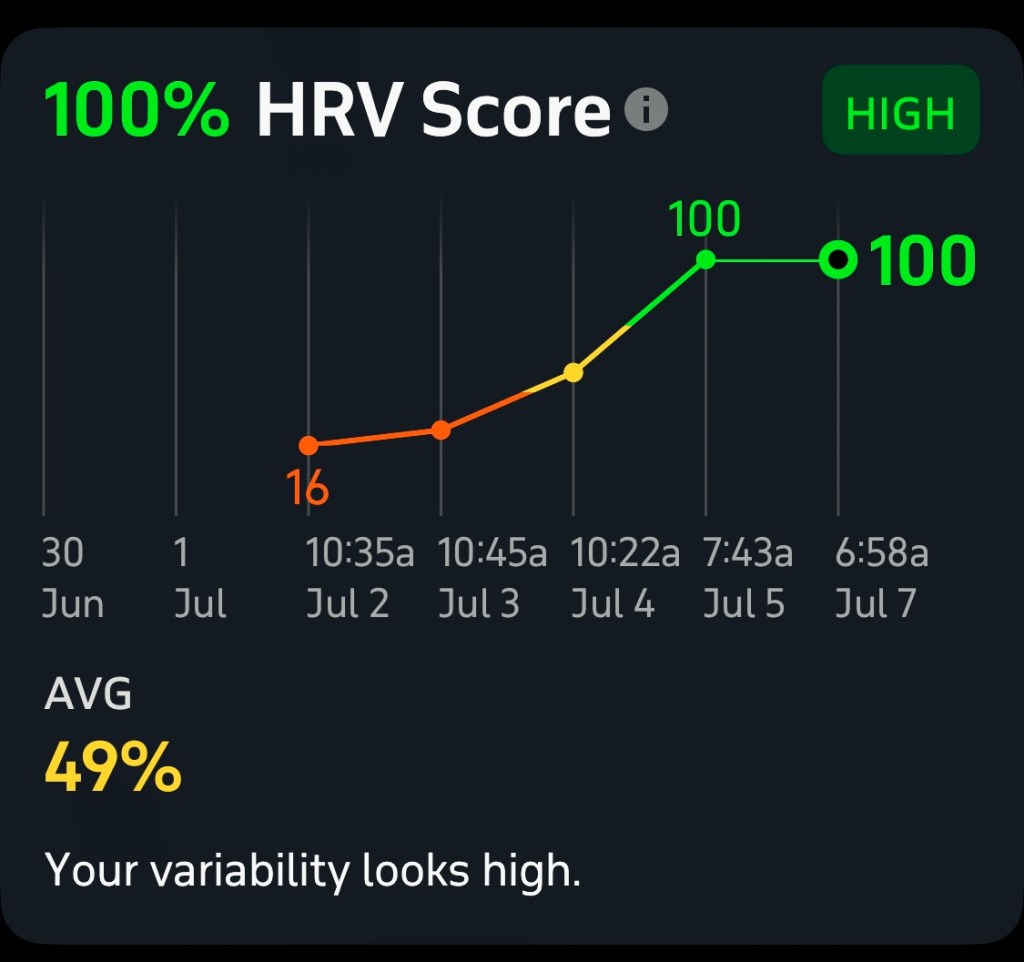
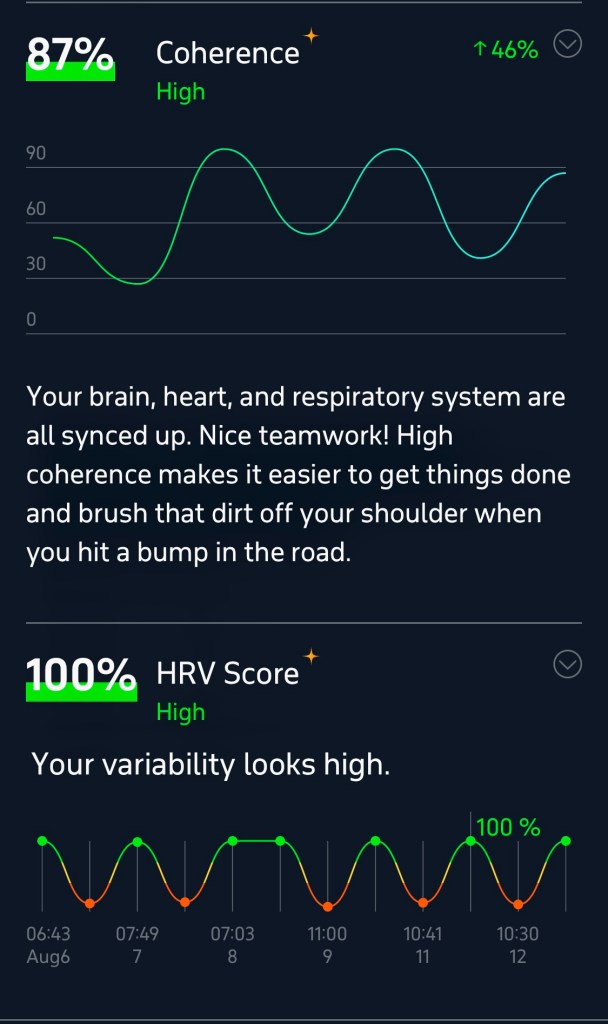
Heart rate variability (HRV) is an interesting metric for me. HRV is the physiological phenomenon reflecting the variation in the time intervals between consecutive heartbeats. Compared to the heart beating at a regular rhythm, the time between beats fluctuates slightly, and HRV measures this variability. The higher the variability the better is the cardiovascular health.
VO2 max, or maximal oxygen consumption, is the greatest amount of oxygen body can take in. It is transported and utilized during intense exercise. It is the best indicator of cardiovascular fitness and aerobic endurance. This is because it measures how efficiently heart, lungs, and muscles use oxygen.
The body can consume more oxygen with a higher VO2 max. This allows it to produce more energy. As a result, this supports better performance in aerobic activities like running, swimming, or cycling. Elite endurance athletes often have very high VO2 max values, demonstrating superior cardiorespiratory fitness.
ScreenshotScreenshotScreenshotScreenshot
A web search too revealed that a VO2 max of 42 would generally place above the “good” range. It is in the “excellent” or even higher percentile for 60-year-old men !!
Besides, I take daily regular counts for Stress, Energy and Health resiliency and Heart Rate Variability (HRV).
For all physical activities I track, I consider several factors. These include Steps per day, Total Time for activity, Average/min/max Heart Rate, Training Effect (aerobic/anaerobic), Total Calories, and Recovery Time.
Last week in training: Some key exercises logged.
Barbell (BB) Sumo Romanian Deadlift (DL) is a super compound exercise. I have progressed decently from the 30 kg to 10 reps each with 65 kg and 75 kg. This was my personal record.
Machine Leg Curls: One of the best leg exercises. Have progressed from 50 kg, 10 reps to 80 kg, 10 reps.
Smith Machine Bench Press and Chest Fly’s: Love the Smith machine. Presently at 50 kg, 8 reps. Built over a period.
Barbell Triceps Extension: Another one I like. Now at a high of 30 kg, 12 reps. Love this.
Machine Chest Press: Built intensity over period and now at 110 kg, 6 reps of – another PR.
Smith Machine Shoulder Shrugs: Love this on the machine. Achieved a PR of 70 kg, 12 reps. another PR.
Seated Back Rows: Love this exercise too. Reached 125 kg, 6 reps, my PR.
The above were a few exercises among several others that I did.
Learning diaries:
Showing up every single day at the gym is half the work done. Progress is bound to happen. Consistency is key.
Key exercises are very important. Give full attention to them and carry out with efficiency.
Form is key. Always be mindful of the form.
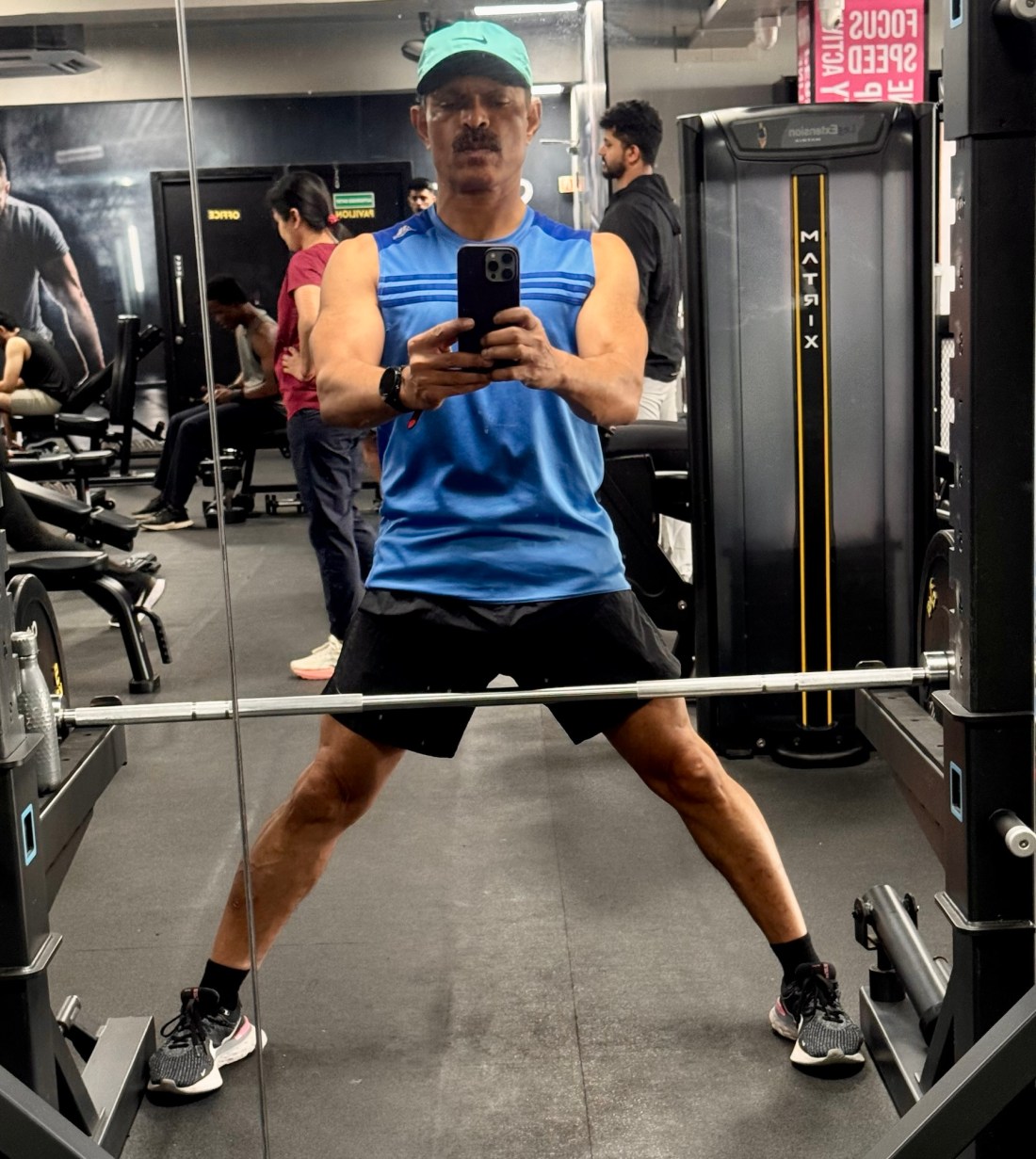
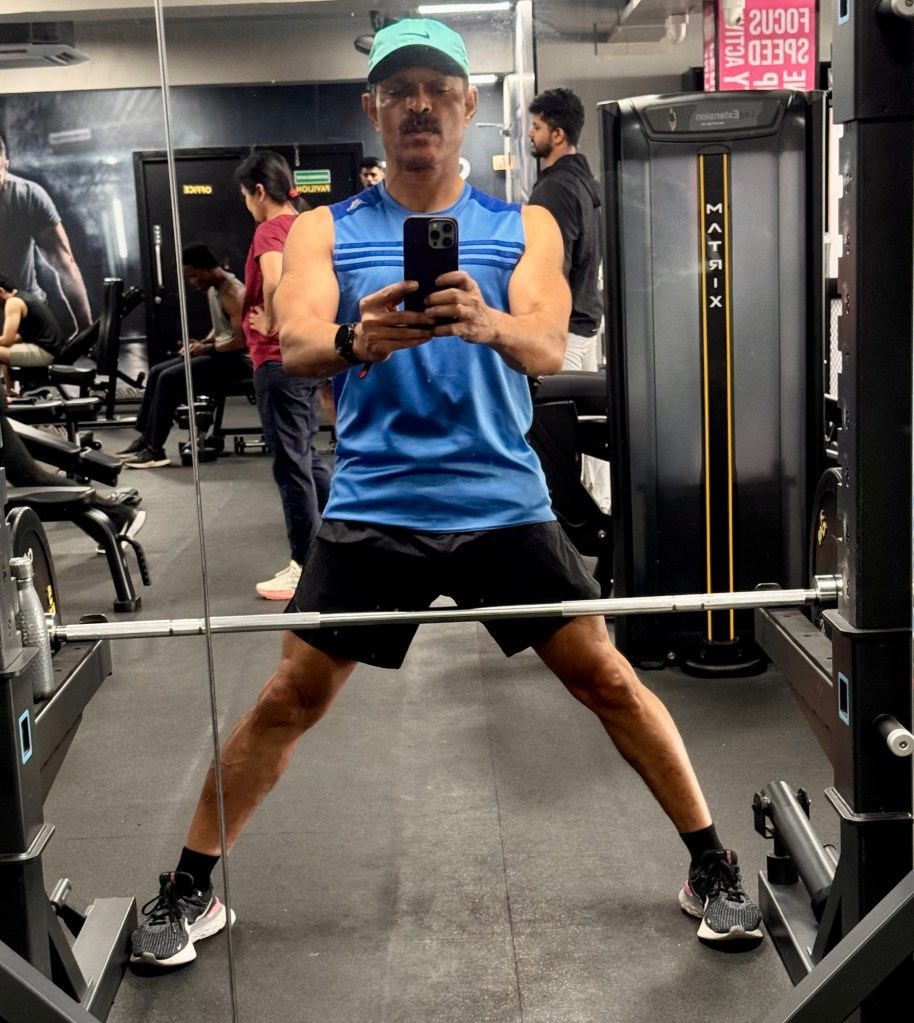
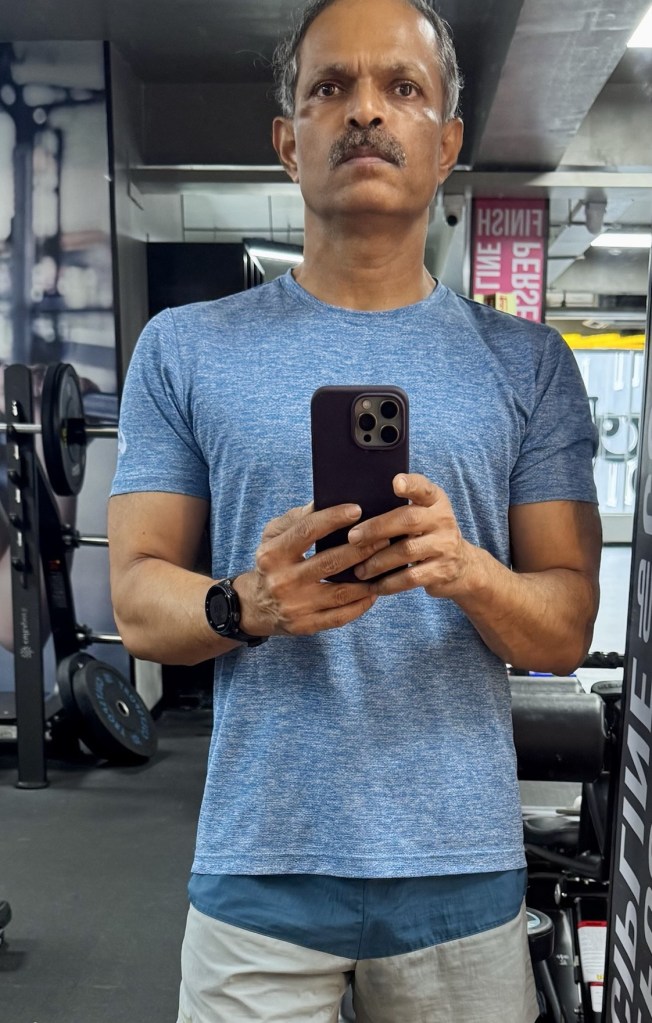
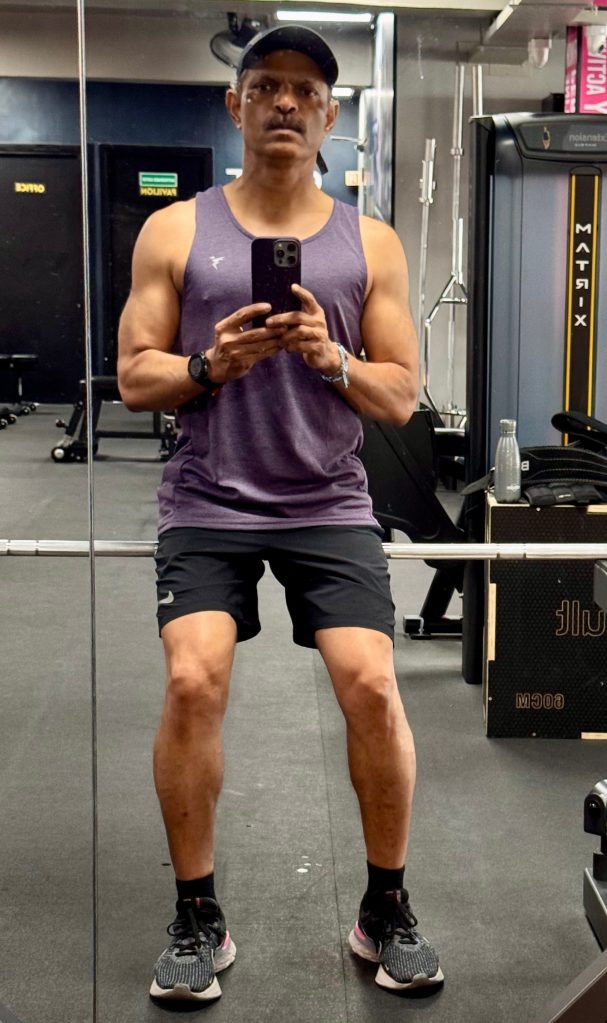
@ the Gym
The fitness journey is a demanding, challenging and a continuous life process. This journey demands consistency, commitment, control, and discipline from you. Yet, the return on investment is huge and visible. It results in better fitness and health. You can beat ill heath, be disease free, build fitness resiliency, and lead a better life!!!
ಪುಟ್ಟ ಪುಟ್ಟ ಕೈಗಳು, ಕೆನ್ನೆ ಬೊಟ್ಟು ಬೋಕ ಗುಳಿಯು ನಕ್ಷತ್ರ ಚುಕ್ಕಿ ಹಾಗೆ ಬೆಳ್ಳ ಬೆಳ್ಳನ ಬೆರಳು ಉಗುರು ಮುಂಗೈ ಹಿಡಿದ ಮುಟುಕಿಯಲ್ಲಿ ಬ್ರಹ್ಮನ ಗಂಟು ನಂಟು ಆಗೊಮ್ಮೆ ಈಗೊಮ್ಮೆ ಬೆರಳು ತೋರಿ ಅಳುವ ಆ ಸೊಗಸು….
ತೆರೆದ ಮುಷ್ಟಿಗಂಟಿನೊಳಗೆ ಹೆಪ್ಪುಗಟ್ಟಿದ ಕೆಂಪು ಬಣ್ಣ ಬೆರಳ ಮಡಿಚಿ ಮುಂಗೈ ಹಿಚುಕಿ ಗುಮುಟಿ ಚಿವುಟಿ ಅಗಲ ತೊಡೆಯು, ಬಾಳೆ ಗೊನೆಯು, ಮೇಲೆ ಕೆಳಗೆ ಅಲಗಿ ಜೆಟ್ಟಿಯಂತೆ ಕಾಲು ತಟ್ಟಿ ಮೆತ್ತಗೆ ಒದೆವ ಗತ್ತು…
ಅಂಗಾಲು ಚಂದ ಹೊಳಪಲಿ ಹಿಂದೆ ಮುಂದೆ ಹಿಂದೆ
ಮೇಲೆ ಕೆಳಗೆ ಆಡಿಸಿದರೆ ಗೆಜ್ಜೆಯ ಗಿಲ ಗಿಲ ಪಂದ್ಯ
ಪಾದ ಪುಟಿಸಿ ಹಣೆಗೆ ಹಚ್ಚಿರೆ ಮೆತ್ತನೆಯ ದೇವ ದೃಷ್ಠಿ
ಹಿಡಿದು ಕೈಯ ಹೆಜ್ಜೆ ನಡೆಸಿರೆ ಅದೇ ಕೃಷ್ಣನ ಸೃಷ್ಟಿ …
ದುಂಡನೆ ಸೊಂಟ ತೊಗಟೆ ಗುಂಟ ಬೆಳ್ಳಿ ಉಡುದಾರ
ಪುಟ್ಟ ಆನೆಯ ಹೊರೆಯು, ತಿರುವು ಮುರುವು ನಡೆಯು
ಪಕ್ಕನೆ ನಕ್ಕರೆ ತೂಗುವ ಹೊಟ್ಟೆ ಹಿಂದೆ ಮುಂದೆ ಸರಿದು
ನಡೆವ ಬೆಡಗು ಜೋಲಿಹೊಡೆಯು ಬೀಳದ ತುಲನೆಯು...
ಮುಖದಲಿದೆ ಶುದ್ಧತೆಯ ಬಣ್ಣ ಶಾಂತತೆಯ ಬಿಳಿಯ ಮೇಳ
ಸಣ್ಣ ಮೂಗು, ಮಿಡಿವ ಬಾಯಿ, ಗುಲಾಬಿ ತುಟಿಯ ಹೋಳು
ಇಷ್ಟಗಲ ಕಣ್ಣು, ಕರ್ರನೆ ರೆಪ್ಪೆ, ಅದರಲ್ಲಿ ಮುಗ್ದ ಹೊಳಪು
ಪಿಳಿಕಿಸಿ ನಕ್ಕರೆ ಮುತ್ತಿನ ಮಳೆ ವಜ್ರದ ಮಿಂಚು ಬೆಳಕು…

ದುಂಡನೆ ಮುಖ ಹೊಳೆವ ಕಳೆ ಬಂಗಾರ ಸೆಳೆವ ಮೆಚ್ಚು
ಉಬ್ಬಿದ ಗಲ್ಲ ಸೊಬಗಿನ ಸೊಲ್ಲ ಕಡಿದರೆ ಕುಡಿಕೆ ಬೆಲ್ಲ
ಗದ್ದದ ಗುಮಟೆ ಸೋರುವ ಜೊಲ್ಲು ನಕ್ಕರೆ ಅದೇ ಸ್ವರ್ಗ
ನಿದ್ದೆಯ ನಗುವು ಕನಸಿನ ಸೆಳವು ದೇವರ ಜೊತೆಗೆ ಮಾತು…

ಮಲಗಿದ ಮಗು ತಟ್ಟನೆ ಎದ್ದು ತೆರೆದ ಅಗಲ ಕಣ್ಣು
ಪಿಚ್ಚಿನ ಹೊನ್ನು ಅತ್ತರೆ ಸುರಿವ ಮುತ್ತಿನ ಕಣ್ಣೀರ ಚೆನ್ನು
ಎಣ್ಣೆಯ ತಿಕ್ಕಿ ಸುಡು ನೀರ ಸುರಿವಿ ಬಟ್ಟೆಯಲಿ ಬೆಚ್ಚಗೆ ಸುತ್ತಿ
ತೊಟ್ಟಿಲ ತೂಗಿ ಮಲಗಿಸಿದರೆ ಅದೊಂದು ಸ್ವರ್ಗ ಸ್ತುತಿಯು…
Thank you for visiting! Grateful to you. I have just stepped into the world of blogging—and I’m loving it. Writing has always been close to my heart. This space is my way of sharing insights. It reflects my thoughts and a little bit of soulsearch…
My blog explores a rich mix of topics—from fitness and inner well-being to anything else that sparks curiosity. You will even find some heartfelt Kannada poetry tucked in there!
What makes this blog different?
Lived experience: I write as a practitioner, not just a commentator. Each post springs from personal practice and real-life exploration.
Depth over gloss: I aim for substance. No superficial takes—just thoughtful reflections that invite introspection.
Variety with purpose: Expect a diverse range of topics, all grounded in meaning and curiosity.
I’m committed to posting regularly and honing this craft along the way. It’s a journey in progress, and I hope it brings genuine value to anyone who reads. My intent is to be informative. Knowledge flows from inner realization.
Thank you for being here. Do take a look, subscribe, and share it with those who might resonate.
















 basavarajgoudar